







July Among the Wildflowers with Jenny Desoutter
With heatwave after heatwave and weeks of unrelenting sun this has been a record-breaking summer. The vines are flourishing, we have all had to spend our evenings watering the garden - but what about wildlife?
As I write this, although we are still not technically in drought, there has been no rain for weeks. Local farmers are struggling to feed their stock as there is no grass left for grazing - and no grass to make hay. It seems miraculous that anything can survive for so long without water, and yet looking round the wild flower areas in the vineyard it seems to be business as usual. A little less well-grown perhaps, and everything flowering early, but still flowering and setting seed.

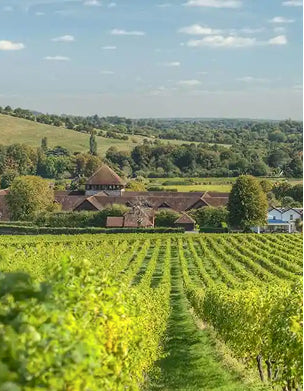
Denbies’ ethos of commitment to looking after the environment has produced many excellent initiatives to support nature, including setting aside these “wild flower areas” among the vines that show how nature can co-exist alongside intensive cultivation.
Mowed just once a year in winter, as nutrient levels drop, dominant grasses gradually give way to an increasing number of wild flowers thus promoting biodiversity. The more species of plant, the more invertebrates can be supported. To hasten this process, two years ago yellow rattle seeds were sown, and already there is a visible increase in diversity and abundance of species, with some new species creeping in to colonise, such as Wild Carrot (daucus carota) in Area C.

These wild flower areas are not about creating a garden - the aim is not show and colour but increase in biodiversity. Every plant has its purpose and its place in the natural web of life, and so when we see proscribed “weeds” such as Ragwort (senecio jacobaea) or Dock (rumex), instead of throwing up our hands in horror we must think what purpose are they fulfilling. For example, Dock supports the stunning Small Copper butterfly, Ragwort hosts the handsome scarlet-and-black Cinnabar Moth. 
Nevertheless, the most successful and eye-catching area so far is the steep chalk hillside of the Dell, Area A. The colourful mix of chalk-loving flowers is once again spectacular: the pinks and purples of Scabious, Knapweed and Marjoram spread washes of colour over the slope mingled with gold of Wild Parsnip, Ragwort and Agrimony, and snowy white drifts of Upright Hedge Parsley. Pink Centaury and blue Harebells grow among them, and through all there is the constant merry-go-round of butterflies and other insects.
Sunny summers have always brought migrant species, such as the Painted Lady, across the Channel, and Areas A and B make perfect wildflower corridors up the steep scarp for travelling insects. As I was enjoying the spectacle of skyey Common Blues and amber Gatekeepers partying among the knapweeds I was delighted to see one of the loveliest butterfly sights of summer: two freshly-arrived Clouded Yellows speeding conspicuously up this floral highway to heaven. 
Global warming has also led to an increase in opportunities for formerly occasional migrants to settle and breed. In our area, the striking Jersey Tiger moth has increased incrementally since 2014 and is now a common sight. At rest its striking stripes of black and cream provide the perfect camouflage in dappled sunlight, while in flight its vivid scarlet, orange or yellow wings make it as eye-catching as a butterfly.
There is more life in every square foot of ground than we can readily see, and while photographing the Upright Hedge Parsley (torrilis japonica) on the steep hillside I was surprised to discover a tiny, but very smart fly, about 5-9 millimeters, ectophasia crassipennis, new to the UK in 2019 and now established and spreading rapidly in our area.
The resilience of nature is remarkable. In spite of the lack of water, plants and butterflies have carried on the vital work of generating new life. There’s no NHS for them, no food bank. They carry on regardless. Soon after the Clouded Yellows two Painted Ladies appeared. One immaculate, the stained-glass patterning on her wings clear and bright, the other faded, with large parts of her wings now missing so that she was almost unrecognisable. Yet she flew from flower to flower as blithely as the other. Despite the toll her active life had taken, her bedraggled appearance, she was still living life to the full, carrying on as normal. An example to us all!
Jenny Desoutter, 27 July 2026